Why Does My Scar Feel Tight or Pulling? Normal Tightening, a “Stuck” Scar or Contracture — the 3-Test Check
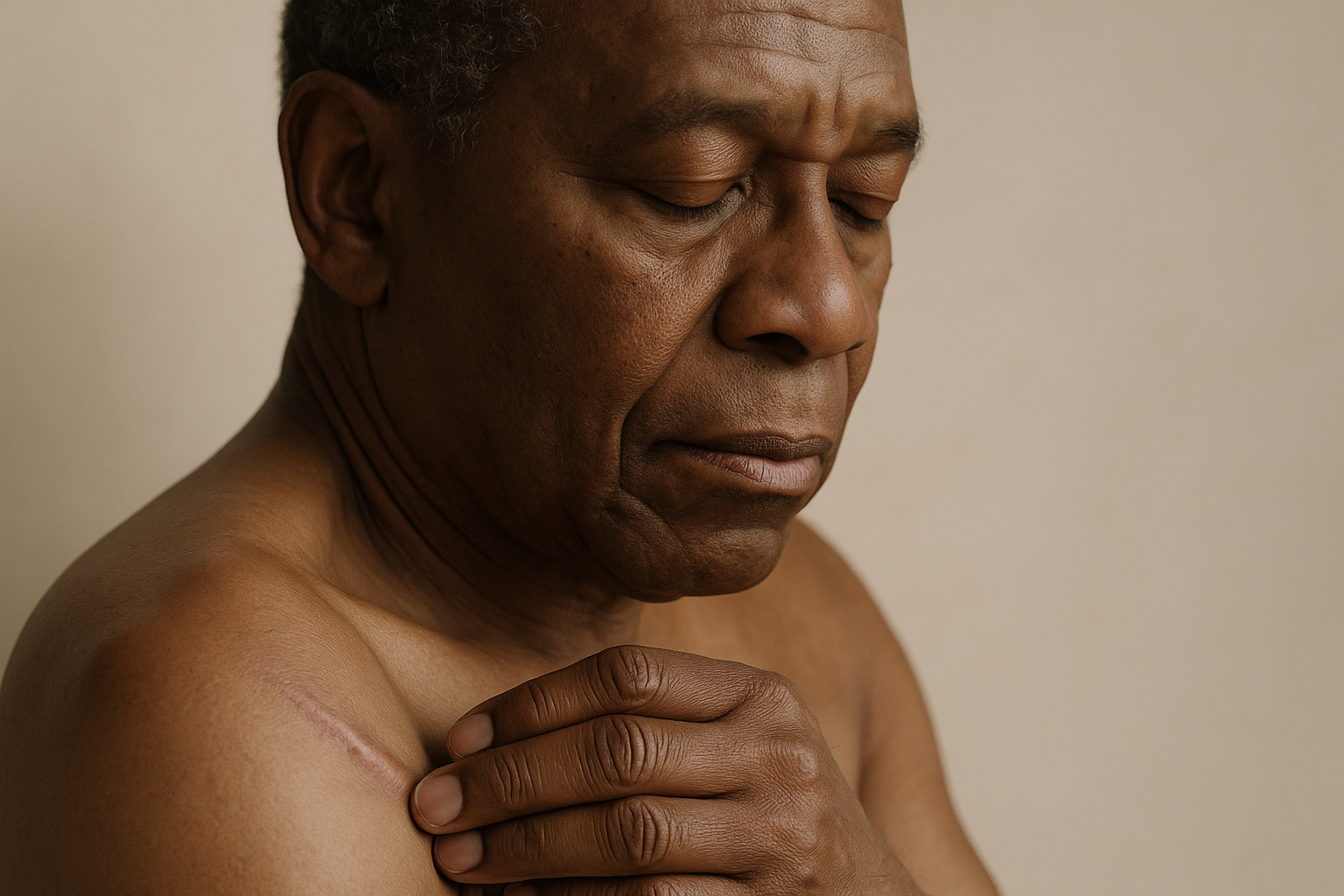
Quick answer
A scar feels tight because scar tissue is built differently from the skin it replaced: it is dense, less stretchy, and while it matures the cells inside it actively pull inward. The Chelsea and Westminster burns-therapy leaflet puts it plainly: deeper wounds heal “by forming scar tissue which shrinks and tightens as it forms.” For most people, mild tightness or pulling in a surgical scar is part of that maturing process, and it eases over months. It deserves a clinician’s attention when it limits movement (especially across a joint), when the scar is hard, red or warm, or when pain is increasing rather than easing. Gentle massage once the skin is fully closed is what NHS hospital leaflets recommend for stiffness, but they disagree on how much, so the table below compares them. A 100% water-free botanical lipid concentrate such as ScarDerma Pro can serve as a glide for that massage on fully closed skin and supports a softer, smoother-looking scar surface — it is a cosmetic product, not a way to release a contracture.
Last updated: 13 October 2026
What the top results miss
Search “why does my scar feel tight” and the first page is mostly patient forums — people comparing notes on mastectomy, knee-replacement and hair-transplant scars — plus a few general articles. The forums are reassuring but cannot tell you which kind of tightness you have. This article does that. It separates four different things people call “tight”, gives you three simple at-home tests to sort them, compares what four current NHS hospital leaflets actually say about massage (they do not agree), and lists the signs that mean stop and call.
Why scars tighten: three mechanisms
1. Scar tissue shrinks as it forms. The Chelsea and Westminster Hospital NHS Foundation Trust leaflet on scar tissue and contractures says deeper wounds heal by forming scar tissue “which shrinks and tightens as it forms,” and adds that “scar tissue tightens 24 hours a day.” That leaflet is written for burns patients, where the effect is most dramatic, but the underlying idea — scars pull in as they form — applies to ordinary surgical scars too.
2. The cells inside the scar contract. In the scar-formation chapter of the open-access Textbook on Scar Management (Darby and Desmoulière, Springer 2020), myofibroblasts are described as having “contractile properties, playing a major role in the contraction,” and the chapter states that “these cells contract, inducing retraction of the scar, particularly when the scar tissue is located in a region subjected to mechanical tension.” Tension and tightness feed each other: the more a scar is under mechanical tension, the more it is pulled on — and the chapter notes that differentiation markers of these cells “appear earlier in granulation tissue that is subjected to increased mechanical tension.” (The same chapter says retraction does not occur in keloids, which is why a keloid is a different problem.)
3. The scar is stiff or “stuck” to what is underneath. The Hull University Teaching Hospitals leaflet on scar care warns that “your scar could become hard and inflexible, or adhesions may form.” King’s College Hospital’s leaflet likewise describes scars that can feel stuck to deeper structures. Rei Ogawa, a plastic surgeon at Nippon Medical School, adds a useful warning sign in his 2021 review: “Any stiffness/hardness, even in a small part of the scar, indicates continued inflammation.” Ogawa’s 2018 editorial notes that the remodelling phase “commences within a week of injury and continues for months” — which is why tightness is common for a long time, not just a few weeks.
Four kinds of “tight” — and what each usually means
This table is our own synthesis of the sources above. It is an orientation aid to help you describe your scar to a clinician, not a diagnosis.
| What it feels like | Most consistent with | Typical pattern | What to do |
|---|---|---|---|
| A mild pulling or “strap” feeling that is worst when you stretch or after sitting still; no loss of movement; scar flat and softening | Ordinary maturing scar tissue | Eases gradually over months as the scar remodels | Moisturise, gentle movement, massage once closed if your team has said it is fine |
| Scar feels hard, thick, raised or ridged; may be pink or red; may itch or ache | Scar still inflamed or under tension (Ogawa: stiffness/hardness indicates continued inflammation) | More likely in taut areas and over joints | Tell your surgeon or nurse; ask about silicone, taping or pressure options |
| The skin around the scar will not glide; the scar feels fixed to what is underneath; pulling when you move that area | Adhesion (“stuck” scar) — Hull and King’s both describe it | Often after deeper surgery; may be worse when you move | Ask for scar mobilisation advice from a physiotherapist or hand therapist |
| You cannot fully bend, straighten or turn the joint or area; the scar blanches or looks stretched as you move | Possible contracture (Hull: a scar crossing a joint “could stop you being able to bend or straighten the joint”) | Most often after burns, large wounds or scars crossing joints | See your team promptly — the Chelsea and Westminster leaflet says early is the most important time to prevent it |
The 3-test check you can do at home
These three tests are our own protocol, designed to answer one question — is this ordinary tightness or something to report? They are not clinical tests, and nothing here replaces advice from your own surgeon or therapist. Do them only on a scar that is fully closed (no scab, no open areas, stitches out).
- The mirror-side test (range of movement). Move the nearby joint or body area through its full range, slowly, and compare with the other side. Can you reach the same positions? Does the scar blanch (go white) or look stretched at the end of the movement? Losing range — not just feeling a pull — is the signal that matters. Note the date and take a photo at the end position so you can compare next month.
- The glide test (adhesion). With clean hands and very light pressure, rest a fingertip on the skin beside the scar and see whether the skin moves a little over what is underneath it, as QVH’s physiotherapy leaflet describes for massage (“so that the skin moves on the underlying scar tissue”). Compare with the same spot on the other side. If the skin is clearly fixed in place, mention it to your therapist.
- The heat-and-colour test (inflammation). Compare the scar’s colour and temperature with the surrounding skin. Hull’s leaflet lists redness, bleeding, a scar that “feels warmer than the skin around it” and “more pain than usual” as reasons to stop massaging and contact your GP or consultant. The same applies whether or not you are massaging.
| Your results | What it points to | Next step |
|---|---|---|
| Full range of movement, skin glides, no heat or colour change | Ordinary tightness while the scar matures | Keep going with your team’s advice; recheck in a month |
| Full range, but skin does not glide | Possible adhesion | Ask about physiotherapy scar mobilisation |
| Reduced range compared with the other side | Possible contracture or deep stiffness | Contact your surgeon, nurse or therapist soon |
| Warm, red, more painful, bleeding or reopening | Not ordinary tightness | Stop massage; contact your GP or consultant |
Scar massage for tightness: four NHS leaflets, four different doses
Everyone agrees on wait until it is closed and on stop if it hurts or opens. After that, the advice varies. Here is what each current leaflet says, as written:
| Leaflet | When to start | How much | Technique | Stop and call if… |
|---|---|---|---|---|
| Hull University Teaching Hospitals (HEY1594/2025; updated 30 Sep 2025) | When your Hand Therapist advises | “at least 10 minutes, 2 or 3 times a day” | Small circles along the scar with thumb or two fingers; then up and down; then across | Redness, bleeding, scar warmer than surrounding skin, more pain than usual |
| King’s College Hospital (PL1309.1, Dec 2025) | Skin completely closed, stitches out, scabs fallen off | “at least 4 times daily for 5 to 10 minutes” | Firm pressure you can tolerate, starting lighter; enough to make the scar lighten in colour | Colour change or warmth, bleeding, more pain than usual, blisters or rash, scar reopens |
| Queen Victoria Hospital (QVH) physiotherapy (print Feb 2021, review due Mar 2024) | Not open wounds | Frequency and duration left blank in the version we read | Slow circles so the skin moves on the scar; gentle pinch-and-roll along the length | Scar becomes sore, blisters, reopens, or a rash develops |
| Chelsea and Westminster (burns therapy) | Therapist-led, once healed | Stretches “gently held for 2-5 minutes each” | Stretching plus positioning/splints under therapist direction | Ask the ward therapist or burns therapy department |
The practical reading: there is no single evidence-based dose. Two leaflets set targets (10 minutes two or three times a day versus 5–10 minutes four times a day), one leaves it blank, and the burns leaflet frames the work as stretching rather than massage. Follow the instructions your own team gave you, and treat these numbers as ranges used by different hospitals, not as a standard. QVH’s leaflet is past its stated review date, so check with the department if you are relying on it.
When tightness needs a clinician
- You are losing movement. If a scar crossing a joint stops you bending or straightening it fully, tell your team. Chelsea and Westminster describes this as the most important time to prevent a contracture, because early scar tissue is “more easily shaped.”
- The scar is warm, red, bleeding, reopening, blistering, or more painful than before. These appear in the stop-and-call lists in the Hull and King’s leaflets.
- It is hard or raised and not softening over months. Ogawa links stiffness and hardness to continued inflammation, and notes that where a contracture is established on a joint, surgical release may be considered. That is a decision for a specialist.
- You are unsure. A short call to the clinic that did your surgery is always reasonable.
The 8-week tightness log
Most people only notice tightness when it is bothering them, which makes it hard to tell whether it is improving. This log is our own protocol and takes two minutes a week.
| Week | Record | Why |
|---|---|---|
| Week 1 | Photo of the scar and of the end-of-range position; score the pulling 0–10 at rest and at full stretch | Baseline |
| Weeks 2–7 | Same photos, same lighting, same time of day; same two scores; note anything new (warmth, colour, itch) | Shows direction of travel |
| Week 8 | Lay week 1 and week 8 side by side; compare range, scores and colour | Falling scores with the same range = ordinary maturing. Same or worse = show your team the photos |
Where a water-free lipid concentrate fits: ScarDerma Pro
Be clear about the job. Nothing you apply to the surface can release a contracture or replace therapy, and ScarDerma Pro does not claim to. What a lubricating lipid concentrate is useful for is the practical side of massage: skin that is dry slides poorly, and QVH’s leaflet notes that scarred skin is often unable to produce its own oil or sweat. Used on fully closed skin, it gives your fingertips something to glide on while supporting a softer, smoother-looking scar surface.
ScarDerma Pro is a 100% water-free (anhydrous) botanical lipid concentrate, formulated by S. C. Aris. Because it contains no water, it needs no preservative system, and its lipids are chosen to sit in the outer layers of the skin rather than evaporating away. It leads with four actives — immortelle helichrysum, rosehip seed, tamanu and pomegranate seed — with Japanese camellia, geranium, English lavender and hemp seed as soothers, on a base of sea buckthorn, calendula, jojoba, hazelnut and vitamin E. There are no harsh acids or peels, no drying agents, no artificial fragrance, no parabens and no fillers; it is vegan and non-GMO. One honest caveat: helichrysum, geranium and lavender are aromatic botanicals, so it is not a fragrance-free product — patch test on unbroken skin near the scar first.
In a customer survey, 91% said their marks looked flatter and smoother within six weeks and 94% would recommend it; these are survey responses, not clinical-trial results, and the survey did not measure movement or tightness. It is rated 5.0 out of 5 from 62 reviews and carries a 90-day guarantee. See ScarDerma Pro →
The boundary, stated plainly: use it only on fully closed skin, and follow your own team’s advice on massage and exercises. If movement is limited, the next step is your surgeon or therapist, not a bottle.
More from our scar cluster: when can you start scar cream? · why is my scar getting wider? · why is my scar indented? · why is my scar shiny? · why is my scar still red? · why is my scar dark? · why is my scar white? · do old scars ever fade?
Frequently asked questions
Why does my scar feel tight and pulling?
Scar tissue shrinks and tightens as it forms, according to the Chelsea and Westminster NHS leaflet, and the cells inside it contract, particularly where the scar is under mechanical tension (Darby and Desmoulière, 2020). Mild tightness is common while a scar matures; losing movement, or a hard, warm or increasingly painful scar, needs a clinician.
How long does a tight scar stay tight?
No source we opened gives a single figure. Ogawa describes the remodelling phase as beginning within a week of injury and continuing for months, so tightness commonly lasts for months. Report it sooner if it is limiting movement.
Is a tight scar the same as a contracture?
No. Tightness is a sensation; a contracture is when scar tissue limits movement. The Chelsea and Westminster leaflet defines it as scar tissue pulling nearby tissues inwards, which can limit joint movement and lead to permanent restrictions. Tightness without loss of movement is a different, more common situation.
Does scar massage help a tight scar?
NHS hospital leaflets recommend it once the skin is fully closed and your team has said it is fine, but they disagree on how much: Hull suggests at least 10 minutes two or three times a day, King’s at least four times daily for 5 to 10 minutes. We found no trial in the sources we read that settles the right dose, so follow your own team’s instructions.
When should I stop massaging a scar?
Stop and contact your GP, consultant or therapist if the scar becomes red, warm, more painful than usual, bleeds, blisters, develops a rash or reopens. Those signs appear in the Hull, King’s and QVH leaflets.
Can a cream or serum loosen a tight scar?
None of the sources we read describes a cosmetic product that releases scar tightness or a contracture. Moisturising and lubricating the skin can make massage more comfortable, and ScarDerma Pro is a cosmetic lipid concentrate intended to support the look of smoother, softer scars on fully closed skin.
Why is my scar tight when I move?
A scar that pulls when you move is under mechanical tension. The Darby and Desmoulière chapter notes that scar retraction is particularly marked in regions under tension, and Ogawa’s 2021 review notes that zig-zag closure is particularly indicated where scars cross a joint. If movement is limited, see your team.
Is it normal for a scar to feel tight months after surgery?
Often yes, because remodelling continues for months. It is worth mentioning to your surgeon or nurse if it is getting worse, if you are losing range of movement, or if the scar is hard, warm or painful.
This article is general information, not medical advice, and does not replace your surgeon’s, nurse’s or therapist’s instructions for your own scar. The three-test check is an orientation aid, not a diagnostic test. ScarDerma Pro is a cosmetic product intended to support the appearance of healed skin; it is not intended to diagnose, treat, cure or prevent any condition, and should only be applied to fully closed skin. See a doctor or therapist if you are losing movement, or if a scar is hard, warm, red, bleeding, reopening or increasingly painful.
Sources
- Chelsea and Westminster Hospital NHS Foundation Trust. Scar tissue and contractures — initial stage (burns patient leaflet; undated). chelwest.nhs.uk
- Hull University Teaching Hospitals NHS Trust. Scar Care: Information for Patient, Carers and Relatives. HEY1594/2025; last updated 30 September 2025. hey.nhs.uk
- King’s College Hospital NHS Foundation Trust. Scar management. PL1309.1, December 2025. kch.nhs.uk
- Queen Victoria Hospital NHS Foundation Trust, Physiotherapy Department. Scar mobilisation. Issue 2, print February 2021, review March 2024. qvh.nhs.uk
- Darby IA, Desmoulière A. Scar Formation: Cellular Mechanisms. In: Téot L, Mustoe TA, Middelkoop E, et al., eds. Textbook on Scar Management. Springer; 2020, ch. 3. NCBI Bookshelf NBK586083
- Ogawa R, Dohi T, Tosa M, Aoki M, Akaishi S. The Latest Strategy for Keloid and Hypertrophic Scar Prevention and Treatment: The Nippon Medical School (NMS) Protocol. J Nippon Med Sch. 2021;88(1). nms.ac.jp
- Ogawa R. Recent Advances in Scar Biology. Int J Mol Sci. 2018;19(6):1749. doi:10.3390/ijms19061749. PMC6032209